

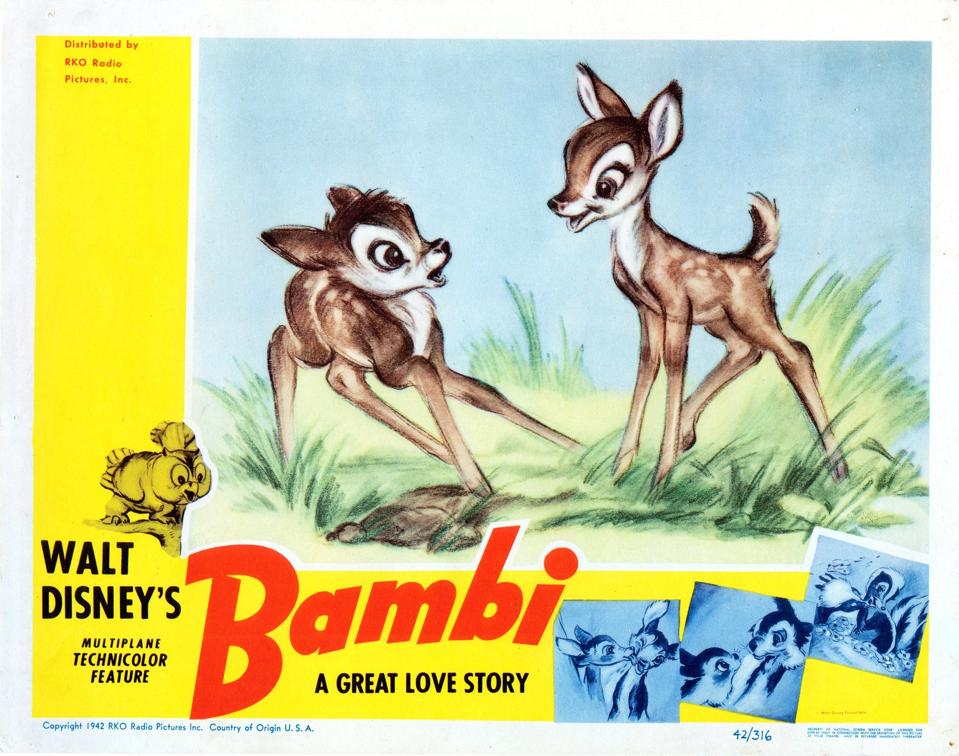
Bambi, lobbycard, 1942. (Photo by LMPC via Getty Images)
LMPC via Getty Images
On this day in 1942, Walt Disney released what would become one of the most influential films in animation history, Bambi. It was one of the first movies to take the realistic portrayal of animals seriously, both in how they looked and how they behaved. It marked a departure from previous Disney entries focused primarily on fantasy and showcased animation’s capability to tackle serious subjects. It inspired early environmental consciousness and highlighted animal rights issues. And Bambi is credited with how future animated films addressed serious topics.
Based on the 1923 novel Bambi, a Life in the Woods by Austrian author Felix Salten, Bambi was Disney’s fifth animated feature film, following (in order of release) Snow White and the Seven Dwarfs, Pinocchio, Fantasia, and Dumbo.
Snow White And The Seven Dwarfs, poster, top clockwise from top left: Bashful, Sleepy, Doc, Dopey, Grumpy, bottom from left: Ferdinand the Bull, Three Little Pigs, Ugly Duckling, Donald Duck on 1940s. (Photo by LMPC via Getty Images)
LMPC via Getty Images
Pinocchio, poster, center: ; clockwise from lower left: Jiminy Cricket, The Blue Fairy, Geppetto, Stromboli, Gideon, Lampwick, The Coachman, Honest John (aka J. Worthington Foulfellow), Figaro, Cleo, 1940. (Photo by LMPC via Getty Images)
LMPC via Getty Images
A Story of Growth, Loss, and Nature
The film, which began production in 1937 but was delayed by technical challenges and World War II, follows a young white-tailed deer named Bambi as he grows up in the forest, learning about life, friendship, love, and survival. Along the way, he befriends iconic characters like Thumper the rabbit and Flower the skunk. But Bambi’s most unforgettable moment is the death of Bambi’s mother, a quiet, devastating scene that shocked audiences in 1942 – and is still talked about today.
That moment marked a turning point in animated storytelling, demonstrating how a children’s film could honestly confront difficult truths.
Bambi, US lobbycard, left: Owl, center left: Thumper, bottom from left: Faline, Bambi, Thumper, Flower, 1942. (Photo by LMPC via Getty Images)
LMPC via Getty Images
Animation as Art
Bambi broke ground in its animation techniques. Disney’s team studied real animals to achieve a level of realism not seen before in animated film. Unlike earlier Disney films, Bambi used music as a subtle emotional guide rather than relying on traditional musical numbers. Songs like “Love Is a Song” and “Little April Shower” became iconic, blending seamlessly into the film’s narration. And, although Bambi faced challenges at the box office during World War II, it grew in popularity over time and is now considered one of Disney’s most artistic and influential films.
In 2011, Bambi was selected for preservation in the U.S. National Film Registry for being “culturally, historically, or aesthetically significant.”
Bambi, poster, bottom from left: adult , adult Faline, Flower, Thumper (second from bottom right), far right bottom: , 1942. (Photo by LMPC via Getty Images)
LMPC via Getty Images
A Lasting Legacy
The attention to realism in Bambi laid the groundwork for future animated blockbusters like The Lion King and Finding Nemo. It showed that animation could be cinematic and serious, not just cartoonish. And it proved that an animated feature could be attraction for all ages – past and present.
Eighty-three years later, Bambi remains a poignant reminder of animation’s power to reflect life’s beauty and pain – and to inspire generations of filmmakers and audiences alike.