

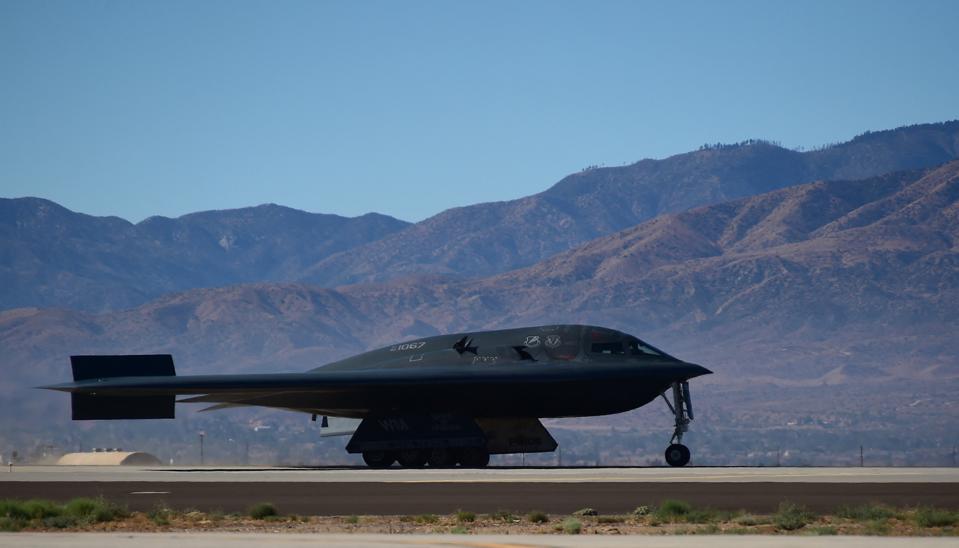
A B-2 Stealth Bomber lands at the Palmdale Aircraft Integration Center of Excellence in Palmdale, … More
The Twelve-Day War between Israel and Iran in June concluded shortly after the United States intervened by bombing Iranian nuclear sites with 30,000-pound bunker busters dropped by strategic B-2 Spirit stealth bombers. The U.S. intervention—the first-ever time America’s military fought alongside Israel in a war—was necessitated mainly by Israel’s complete lack of such bombers and munitions. The war has led to fresh calls in Washington to equip Israel with these capabilities.
Introduced by U.S. Representatives Josh Gottheimer (Democrat-New Jersey) and Mike Lawler (Republican-New York) on Wednesday, the bipartisan Bunker Buster Act aims to authorize President Trump “to support Israel’s defense by providing the Massive Ordnance Penetrator (MOP), or ‘bunker buster’ bomb, and the aircraft required to deploy it – to take out Iran’s underground nuclear infrastructure.”
“Equipping Israel with this capability directly strengthens American national security by eliminating Iran’s pathway to a nuclear weapon,” the bill added.
While it did not explicitly mention the B-2, “the aircraft required to deploy” the GBU-57A/B MOP unquestionably refers to the U.S. Air Force’s sole strategic stealth bomber since that’s the only aircraft presently certified to carry it. Israel doesn’t have any heavy bombers, stealthy or otherwise, capable of carrying such gigantic bombs. Its only manned stealth aircraft is the F-35 Lightning II strike fighter, which, of course, is far too small to carry the MOP in its internal bay or on any external hardpoints. (Israel’s lack of any heavy bombers even led analysts to question the feasibility of Israel dropping a GBU-57s out of the back of its turboprop C-130 Hercules transport planes!)
The Bunker Buster Act isn’t the first proposal to furnish Israel with strategic air power—Gottheimer already proposed it twice in the last three years—and probably won’t be the last if it doesn’t pass. In a June 19 editorial, Michael Oren, Israel’s ambassador to the United States from 2009 to 2013, recalled that he repeatedly requested Washington sell Israel at least one B-52 Stratofortress bomber, confident that it dismiss out of hand any request for its much newer B-2 or B-1 Lancers.
“By selling us even one B-52, I told White House officials, the United States would be sending an unequivocal message to the Iranian regime regarding America’s commitment to preventing Iran from producing nuclear bombs,” Oren wrote.
In the piece, he recounted twice requesting the B-52 in 2013 and for a third time in 2018 to no avail. It’s worth recalling that the U.S. never exported any of its three strategic bombers, meaning that even a sale of the vintage B-52 would have proven unprecedented.
An April 2014 Wall Street Journal editorial similarly advocated that the U.S. should supply surplus B-52s to Israel, although called for a dozen rather than just one, along with MOPs. The latter case was derided shortly thereafter as “a silly little proposal with approximately zero chance of actually being implemented.”
Such criticism of proposals to supply Israel with the B-52 highlighted that iconic bomber’s lumbering speed and complete lack of any stealthiness, which would have left it highly vulnerable to Iranian air defenses and even Iran’s aged air force. Nevertheless, Israel’s 12 days of airstrikes rendered much of Iran’s air defense capabilities wholly ineffective. Furthermore, the Israeli Air Force helped clear a path for the U.S. Air Force B-2 strike on June 22, Operation Midnight Hammer, by targeting air defenses across southern Iran in the preceding 48 hours.
While using a B-52 for such a mission would have proven much more risky than using the B-2, Israel could undoubtedly have conducted an operation like Midnight Hammer independently had it possessed B-2s. It may have even proven capable of striking those nuclear sites with B-52s, given the extent to which it degraded Iranian air defenses. After all, it already excelled at suppressing enemy air defenses with its fighter jets. Israeli fourth-generation fighters even operated in Iranian airspace without any losses throughout the war.
Logistical and technical considerations aside, the supply of B-2s and MOPs to Israel could be promoted politically as a way of avoiding America becoming entangled in another Israel-Iran War. In his editorial, published three days before Midnight Hammer, Oren also argued that had Washington granted his B-52 request, “Israel would not be in a position of wondering whether the United States will perform the task for us.”
“We would mitigate the claims, now being made by both the left and the right in the United States, that Israel is dragging America into another endless Middle Eastern war,” he added.
As stated above, Operation Midnight Hammer was the first time the United States directly entered a war on the side of Israel. Typically, it has supplied or sold Israel the means and munitions to fight its conflict by itself. An apt example of this was Operation Nickel Grass during the October 1973 Arab-Israeli War, when the Nixon administration airlifted large quantities of hardware, including fighters and tanks, to directly replenish heavy Israeli losses as the war was still raging. U.S. pilots flew fighter jets directly to Israel and gave them to their Israeli counterparts but did not directly participate in any combat.
After the U.S. successfully convinced Israel not to retaliate to Iraq’s Scud missile attacks during the 1991 Persian Gulf War, Washington rewarded it with supplies of surplus F-15 and F-16 fighter jets along with AH-64 and UH-60A helicopters.
If the Bunker Buster Act ultimately passes—and again, that’s a big if—a U.S. provision of B-2s and MOPs could indicate Washington has reverted to that long-established pre-June 22 status quo. In other words, while the Israel-Iran War may not have been a one-off, direct U.S. military involvement in support of an Israeli offensive could well have been precisely that.