

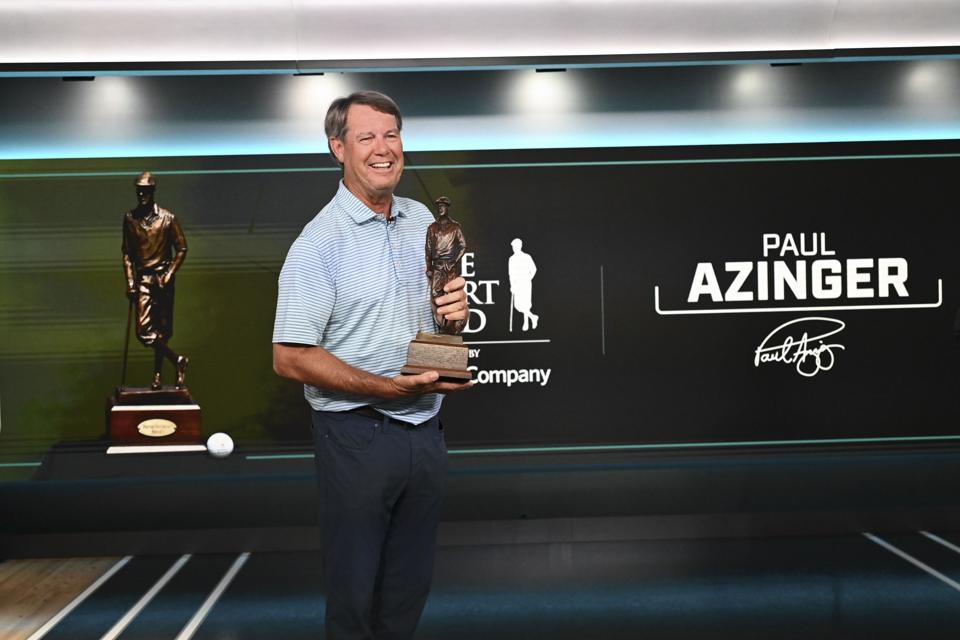
Paul Azinger recieves the Payne Stewart Award
Paul Azinger, the 12-time PGA Tour winner, Ryder Cup hero and longtime broadcaster, has been named the 2025 Payne Stewart Award recipient. Presented annually by Southern Company, the honor recognizes a player whose career reflects Stewart’s legacy of character, sportsmanship, and generosity of spirit.
The PGA Tour has a track record of big award ambush surprises and conspired with Paul’s manager and the producers of The Drop on Golf Channel, a weekly primetime show, to contrive an interview ruse to deliver the news under the guise of a routine segment.
“So, I was doing this fake interview, and Matt Every asked if there was anyone from my era I never got to analyze that I would have liked to talk about as a broadcaster,” Azinger explained.
As he took the bait and began to wax nostalgic about Payne Stewart—the Tam O’Shanter-wearing, three-time major winner whose bronze statue is a must-selfie spot for every golfer who plays Pinehurst No. 2—he turned around and was stunned to see Tracey Stewart standing there holding the trophy.
“I don’t like surprises—I don’t know anyone who does. They caught me on camera, and I don’t know how it’ll turn out to be honest, but it was emotional. It took getting out of that room for me to really feel the emotion of it. I’m really honored, big-time.”
“I’m not sure why they don’t just tell you. I think they’ve fallen in love with the idea of totally shocking you to death. It was just a colossal surprise,” he added.
The award is especially meaningful to Azinger as he was more than a contemporary of Payne’s, he was also a dear friend. He delivered the eulogy at Stewart’s funeral after the golf legend’s untimely passing.
When Paul and Payne first met up at tour event in the early 1980s, after making introductions Azinger found his gaze fixed on one of Stewart’s lobes at what he thought was a quirky earring tat turned out to be an acupuncture needle.
‘It helps me concentrate’ Stewart, who went on to win the tournament, told him. It didn’t take long for Azinger to realize that his new tour buddy was certainly out preparing him.
“All I could think about was ‘man this guy, he thinks on another level than me.’ I never thought about going to different lengths or depths into concentration, visualization, and all that relaxation stuff until that moment. I already got better just shaking his hand and asking about that acupuncture in his ear.”
“Standing out is part of his legacy—not blending in,” Azinger said of his fashion plate friend. “He didn’t want to dress like everybody else, and we all saw him change it up.” Rocking colorful throwback threads, Stewart was never just another guy on the range.
He made sure to play as many practice rounds with Payne as possible, shadowing his rhythms and routines in hopes that some of Payne’s magic might rub off. Just as compelling, though, was the simple fact that they always had a blast together.
“He was fun to play with, whether you were trying to beat him or not,” Azinger explained. They won what is now known as the Arnold Palmer Invitational (back then it was called the Hertz Bay Hill Classic) in back-to-back years and then in the ensuing years had a buddy battle going as to who would be the first to win Jack Nicklaus’ tournament. Stewart started the Sunday of the 1993 Memorial Tournament three strokes ahead of Azinger but by the tourney’s 72nd hole that lead had been whittled down to striking distance.
“We both wanted to win Jack’s tournament before the other guy and I ended up holing out of the bunker to get him and he had me beat all day. It was the most emotional thing,” Azinger recalled.
On the philanthropic front, Azinger was in awe that Stewart had decided to donate his winnings from the 1987 Bay Hill Classic to charity, gifting the entire $108,000 to a Florida hospital in memory of his late father.
“That was a lot of money, and I just thought, this guy is so charitable.” Later, Azinger would learn the extent of Stewart’s impact. “After Payne passed away, Michael Jackson looked at buying his house in Orlando. When they told him whose it was, he said, ‘Oh yeah, the guy in the knickers!’ Even Michael Jackson knew Payne. I don’t think we realized how big Payne was until he was gone.”
Paul Azinger putts with a pitching wedge after breaking his putter in frustration during his opening … More
Putter Breaking To Legacy Building
Azinger famously snapped his Ping Anser in two during the 1996 Open Championship—an endlessly replayed clip on linear television in the era before social media. He couldn’t help but wonder how that lowlight squares with years later receiving an award that celebrates character.
“Everybody saw it. How can I get this character award?” he said, perhaps workshopping a zinger he might weave into his acceptance speech. “We’re all human, right?”
But his arc from fiery competitor to Ryder Cup ringleader to philosophical elder statesman speaks volumes. “You get to a point where you can make a living, and then you want to make history,” Azinger said. “But I don’t think you realize that maybe you’re making a legacy at the same time. I never even said the words ‘my career’ during my career until I heard someone else say it who’d been at it 20-some years. I thought, ‘Wow—I guess I’ve had a career.’ You’ve made a career out of golf, and that takes getting older to even say the word. And then suddenly it’s a legacy. To get rewarded for it—it’s just humbling to me.”
A dedicated advocate for children and families, Azinger and his wife Toni, opened the 12,000‑square‑foot Azinger Family Compassion Center in 2021 on One More Child and Guardian Angels of Southwest Florida’s campus in Palmetto.
The facility serves as a donation and distribution hub, providing a hand up to foster children, hungry children, single mothers, trafficking survivors, and struggling families. They partner with local charities to distribute essential items like clothes, food, diapers, and household goods across the community. In the past 12 months alone, the center has distributed nearly $19 million worth of supplies and supported more than 190 area nonprofits.
“You don’t realize that there is that much to be given away and there is that much to be needed,” Azinger said. “This has proved it. Everything in our building—you come back two weeks later, it’s all different stuff. All the stuff you saw two weeks ago is gone and there is new stuff.”
Azinger, whose wife Toni co-founded the Florida Human Trafficking Victims Fund—also hosts the annual Teeing Off to Stop Human Trafficking golf tournament in November, benefiting both the fund and One More Child.
“Our goal is to rescue kids,” Azinger said. “We have a heart for One More Child—if it’s just one, it matters. Human trafficking is such a big issue now,” Azinger said, acknowledging the enormity of the issue. “We’re just trying to be in service to those kids.”
1993: Portrait of Paul Azinger of the USA with the trophy after winning the PGA Championship at the … More
Prime Time Zinger
Before he became an acclaimed Ryder Cup strategist—trailblazing the 2008 pod system that snapped a nine year drought for Team USA—Azinger authored one of the PGA Championship’s most thrilling finishes.”
On the Sunday of the 1993 PGA Championship at the Inverness Club, Azinger caught fire on the back nine, birdieing four of the final seven holes to draw even with Greg Norman and force a sudden-death playoff. With the pressure of the Wanamaker Trophy hanging on them, both players flubbed birdie attempts on the first extra hole.
On the second, Norman left his birdie putt four feet and change shy of the hole while Azinger lipped out on his, a touch too aggressive with his stroke but still in dandy shape as he was left with a tap in for par. With the burden to perform in the clutch back on the Aussie, Norman buckled, failing to correctly judge the right to left break of his downhill putt causing his sphere to spin off the left edge of the cup.
Azinger’s breakthrough meant shedding the “best player never to win a major” tag while deepening Norman’s rep for being perennially snake bitten in majors. While he’d win the Open twice including that season, the Great White Shark would end up racking up eight runner-up finishes in golf’s biggest events.