

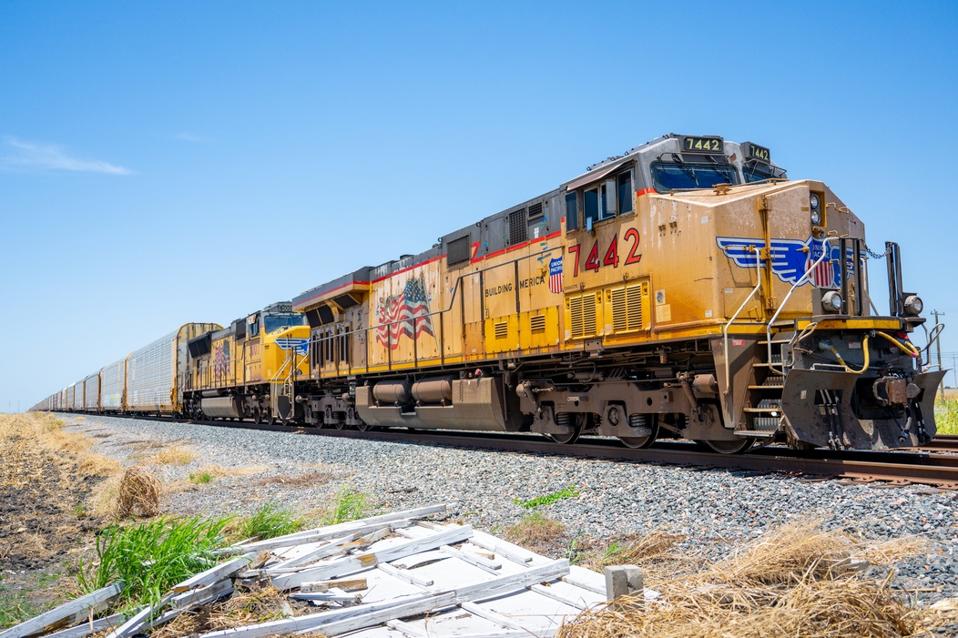
HUTTO, TEXAS – JULY 29: A Union Pacific freight train travels on July 29, 2025 in Hutto, Texas. Union Pacific has reached an agreement to purchase Norfolk Southern in a $85 billion deal. The acquisition forms the United States’ first coast-to-coast rail network, spanning over 50,000 miles from East to West. (Photo by Brandon Bell/Getty Images)
Getty Images
America’s industrial engine is built on logistics. Nowhere is this more apparent than in the petrochemical sector, where the ability to move high-value commodities like oil, natural gas, and other petroleum products efficiently across the country and to the world can make or break a company’s bottom line. Proponents of the proposed merger between Union Pacific and Norfolk Southern believe it will unlock new benefits for this important American sector.
Creating More Efficient Petrochemical Supply Chains
If approved, this $85 billion merger could do something Washington has talked about for years but rarely delivered: dramatically increase the efficiency of a critical U.S. supply chain without costing taxpayers a dime. It’s something of a novel concept in this period of time, but that model is undergoing radical change.
For those unfamiliar with the inner workings of American rail, the current network is a patchwork. A shipment of plastic resins or ammonia traveling from the Gulf Coast to the Midwest or from Texas to the ports of the Southeast will likely need to be handed off between two or even three Class I railroads. Each interchange adds time, cost, and risk. When you’re talking about millions of tons of highly valuable, heavily regulated products, those inefficiencies scale fast.
A combined Union Pacific – Norfolk Southern would change that dynamic. The new system would connect an important western U.S. rail network with one of the East’s most strategically positioned carriers. That means petrochemical shipments from Houston or Lake Charles could travel all the way to Pittsburgh, Savannah, or even Norfolk on a single rail line. Fewer interchanges, fewer delays, fewer headaches. The economies of scale it could generate would resemble the cost-savings achieved from ExxonMobil’s buyout of Pioneer Natural Resources and major oil and gas mergers in the Permian Basin in recent years.
Tanks and towers of petrochemical plants along Houston Ship Channel at sunrise.
getty
For the Gulf Coast – a region that accounts for nearly 90% of U.S. based petrochemical production – the potential benefits are enormous. Thanks to abundant natural gas feedstocks and decades of infrastructure investment, it’s now one of the world’s leading exporters of polyethylene, polypropylene, methanol, and other foundational products used in nearly every manufacturing sector. But getting those products to market requires reliable inland logistics and access to multiple ports. Right now, most exports leave through the congested Port of Houston. This merger could shift some of that pressure east, improving both capacity and competitiveness.
Rising Global Demand For American Petrochemicals
There’s also a global context here that should not be overlooked. Demand for U.S.-made petrochemical products is soaring, especially in Asia and Latin America. As countries shift away from coal and crude oil as feedstocks and embrace gas-based derivatives, the U.S. advantage becomes even more pronounced – if we can get the product to market efficiently. That’s a big “if” under current infrastructure constraints. A UP – NS merger could help solve that.
Some critics have raised concerns about consolidation. That’s standard for any major freight rail merger. But this one is different. The geographic overlap between Union Pacific and Norfolk Southern is minimal. This isn’t a market grab – it’s a connectivity play. Unlike mergers that consolidate market share in one region, this deal would improve cross-country service and provide a stronger East-West alternative to the recently merged Canadian Pacific–Kansas City Southern, which now runs uninterrupted from Canada to Mexico. The merger would actually enhance competition, especially along East-West routes by creating a second transcontinental carrier with scale and reach.
Petrochemicals Need A Win
Rail isn’t the flashiest part of the energy or manufacturing value chain, but it’s among the most important. As energy markets evolve, feedstock flows shift, and trade patterns realign, infrastructure flexibility and efficiency become increasingly critical. The UP – NS deal is more than a business transaction – it’s a step toward building a smarter, more integrated logistics network that reflects the needs of modern industry.
The Surface Transportation Board will have the final say, but the case for approval is strong, especially in an administration heavily focused on raising the competitiveness of the U.S. energy system. The petrochemical industry – and the broader U.S. economy – could use a win like this.