

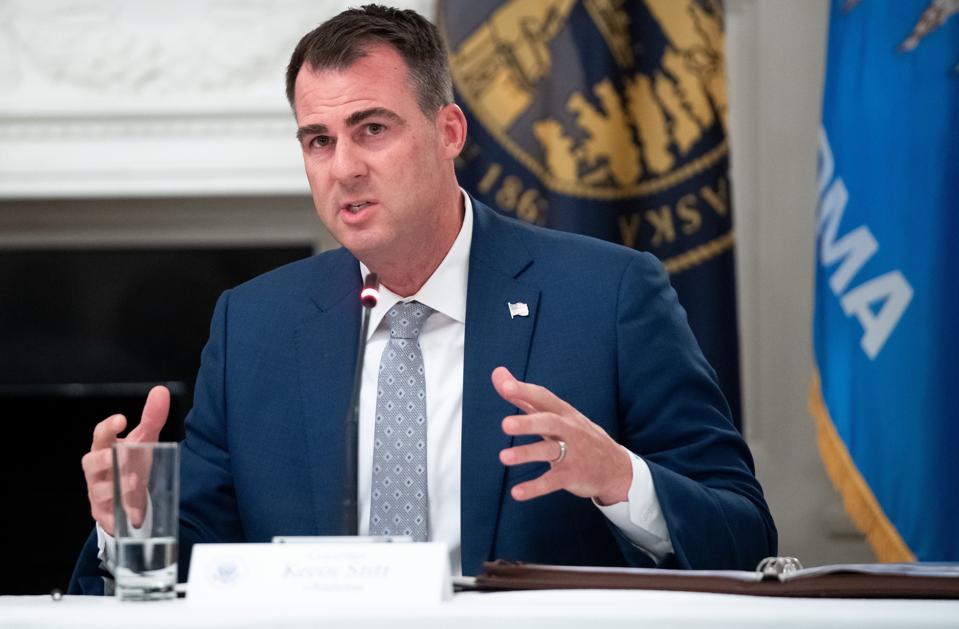
Oklahoma Governor Kevin Stitt speaks during a roundtable discussion with US President Donald Trump about economic reopening of closures due to COVID-19, known as coronavirus, in the State Dining Room of the White House in Washington, DC, June 18, 2020. (Photo by SAUL LOEB / AFP) (Photo by SAUL LOEB/AFP via Getty Images)
AFP via Getty Images
Illinois Governor J.B. Pritzker (D) signed Senate 328 last week, making it easier to sue companies that do business in Illinois but are based elsewhere. The new law requires “companies registered to do business in Illinois to consent to what is known as the state’s ‘general jurisdiction,’” notes Joe Tabor, director of legal research as the Illinois Policy Institute, adding that SB 328’s enactment will allow businesses to be sued in Illinois courts “even if the plaintiffs were not from Illinois and even if the harm did not occur in the state.”
“What that means in practice is that any company registered to do business in Illinois would be opening itself up to a higher-than-normal level of litigation,” Tabor added. Governor Pritzker’s red state counterparts, meanwhile, have sought to reduce the threat and cost of litigation in their states through tort reform, underscoring another aspect in which red and blue state lawmakers are pursuing contrasting policy goals.
In April, Georgia Governor Brian Kemp (R-Ga.) signed into law Senate Bills 68 and 69, a two-bill tort reform package that aims to bring down insurance rates and other business costs. The reforms enacted in Georgia focused on “phantom” damage awards and “jury anchoring.”
“‘Phantom’ damages are awards based on inflated medical bill amounts that were never actually paid — Georgia courts often base awards on these billed amounts rather than real payments,” notes the American Tort Reform Association (ATRA). “Jury anchoring is a practice in which lawyers suggest an unreasonably large award before a jury with that number becoming an ‘anchor’ point in jurors’ minds.
The tort reform package enacted in Georgia this spring also addresses liability issues that were saddling employers with significant litigation costs. Protecting American Consumers Together, an advocacy group dedicated to ending lawsuit abuse that was the only outside group to run television ads in support of Governor Kemp’s tort reform package, praised its enactment, saying that SB 68 and 69 will “make Georgia more affordable for families and small businesses while fixing a broken system to ensure consumers and victims can still seek the justice they deserve.”
SB 68 addressed the expansion of premises liability, which was causing Georgia business owners to be held liable for criminal acts committed on or even near the business property, even in instances when the business owner had no involvement and no ability to prevent the crime. Chris Clark, president and CEO of the Georgia Chamber said that the tort reform package signed into law by Governor Kemp this year “fulfills the Georgia business community’s promise to do right by Georgians by restoring balance to the civil justice system so our courts can focus on justice—not jackpots.”
One month after Governor Kemp and Georgia lawmakers enacted tort reform, Governor Kevin Stitt (R) and Oklahoma state legislators followed suit. At the end of May, Governor Stitt signed Senate Bill 453, which sets a $500,000 maximum award for non-economic damages related to physical injuries, and a $1 million cap for permanent mental injury.
Not only did Governor Stitt and Kemp both enact tort reform this year, they also both approved further income tax relief. The same week that Governor Stitt signed tort reform into law, he also signed legislation cutting Oklahoma’s personal income tax from 4.75% to 4.5%. Meanwhile in Georgia, Governor Brian Kemp signed into law a retroactive income tax cut that will take the rate in 2025 from 5.39% to 5.19%, then down to 5.09% in 2026, followed by another cut to 4.99% in 2027.
The enactment of tort reform in Georgia has been noticed in competing states. As Texans for Lawsuit Reform (TLR) noted shortly after the passage of tort reform in Georgia, many are “urging Texas legislators to pass similar reforms through SB 30,” legislation introduced by Lt. Governor Dan Patrick (R). SB 30 aimed “to prevent abusive lawsuit practices by many plaintiff lawyers that wrongfully inflate medical damages in personal injury lawsuits,” explains TLR.
“Critically, SB 30 would limit the evidence of medical damages that plaintiffs may submit at trial to 300% of the 2025 Medicare reimbursement rate with an adjustment for inflation,” TLR noted. “The provision is meant to prevent lawyers from ‘colluding with providers who over-diagnose, overbill and overtreat’ victims to come up with inflated medical charges. Additionally, SB 30 makes clear that noneconomic awards cannot be used to punish defendants, make an example to others or serve a social good.”
Another piece of the tort reform package that the Texas Senate passed this year is Senate Bill 39, legislation introduced by Senator Brian Birdwell (R) that clarifies the commercial vehicle litigation process in an effort to stop frivolous lawsuits that threaten the livelihood of truckers.
“The explosion of lawsuits (many of them frivolous) against trucking companies in Texas has caused insurance rates to skyrocket, hurting Texans and our businesses,” Lt. Gov. Dan Patrick said back in April after the Senate passed SB 39. “By passing SB 39, the Texas Senate has taken a major step toward providing judges a clear approach to collision cases. These changes will speed up collision trials involving commercial motor vehicles so victims get justice quicker while decreasing legal costs for Texas businesses.”
Florida’s Tort Reform Success Story
Lt. Governor Patrick, Senator Birdwell, and other tort reform proponents in Texas can see the benefits of tort reform by looking at what has transpired in Florida. A July report from the Consumer Protection Coalition (CPC), a group affiliated with the Florida Chamber of Commerce, highlights how insurance rates have plummeted since Governor Ron DeSantis (R) and the Florida Legislature enacted lawsuit abuse reform in 2023.
The CPC touts the fact that the amount of litigation in the state has declined by 30% since Governor DeSantis signed legislation in 2023 that “reduced risk-free litigation through the elimination of the one-way attorney fee statute that forced insurers out of business or out of the state.”
“In addition to the property insurance stabilization, auto insurance costs are also dropping in Florida with major companies recently filing for rate reductions between 6% to 10.5%,” the group added.
“For 2025, Florida’s top five auto writer insurance groups are indicating an average -6.5% rate change, down from an average +4.3% in 2024 and a staggering average of +31.7% in 2023,” noted a July 29 statement from the Florida Office of Insurance. “The top five auto writer insurance groups amount to 78% of Florida’s auto market. In addition to optimistic auto rate changes, Florida is reporting a remarkable reduction in the personal auto liability loss ratio, down to a 53.3% on average in 2024—the lowest in the nation.”
“Thanks to Governor DeSantis and recent strong legislative reforms, Florida’s auto insurance market is turning the corner,” said Blaise Ingoglia, Florida’s Chief Financial Officer. “When the top insurers in the state are cutting rates by up to 11.5%, that’s not just a statistic, it’s money back in the pockets of Florida residents.“
Tort Reform Opponents Helped Finance Texas Walkout
It’s not lost on many in the Texas capitol that the same interests who blocked tort reform from passing during the regular session earlier this year also helped finance Texas Democrats’ latest quorum-blocking walkout. As the Texas Voice recently reported, “campaign finance records show that one of the leading groups working to thwart Republican redistricting efforts has received significant funding from George Soros and personal injury trial lawyers.”
“The political arm of the American Association for Justice, a national trade association for personal injury trial lawyers, has donated $50,000 to the National Democratic Redistricting Committee so far this year,” the report added.
It’s not surprising that trial lawyers would work against a redistricting effort that could result in more tort reform supporters being elected to office. Though tort reform was not part of the final version of the One Big Beautiful Bill Act that President Donald Trump signed into law on July 4 on account of reconciliation constrictions, its inclusion in the House-passed version of the bill indicated that tort reform is a priority for many in Congress. Democratic takeover of the U.S. House next year would mean that federal tort reform is no longer an imminent threat, so it’s logical that the trial bar would want to help thwart congressional redistricting in Texas that would make a Democratic House takeover in 2026 less likely.
Texas is notably the place where trial lawyers most recently defeated tort reform. Though the aforementioned reforms passed out of the Texas Senate this year, they subsequently died after Texas House members added poison pill amendments. Many expect those proposals to be reintroduced at some point in the future, likely for the next regular session in 2027.
Aside from Texas, tort reform also came up short this year in South Carolina. Despite those setbacks, proponents of tort reform notched significant legislative victories in 2025, which will likely be emulated by lawmakers in other state capitals in the coming year. The results from Florida, meanwhile, will likely encourage tort reform proponents in Texas, South Carolina, and elsewhere to persist, as will the actual experiences of employers. Trial lawyers can continue to bring legislators campaign checks, but lawmakers in Austin, Columbia, and other state capitals will continue to field employer complaints about rising insurance rates and litigation costs.