

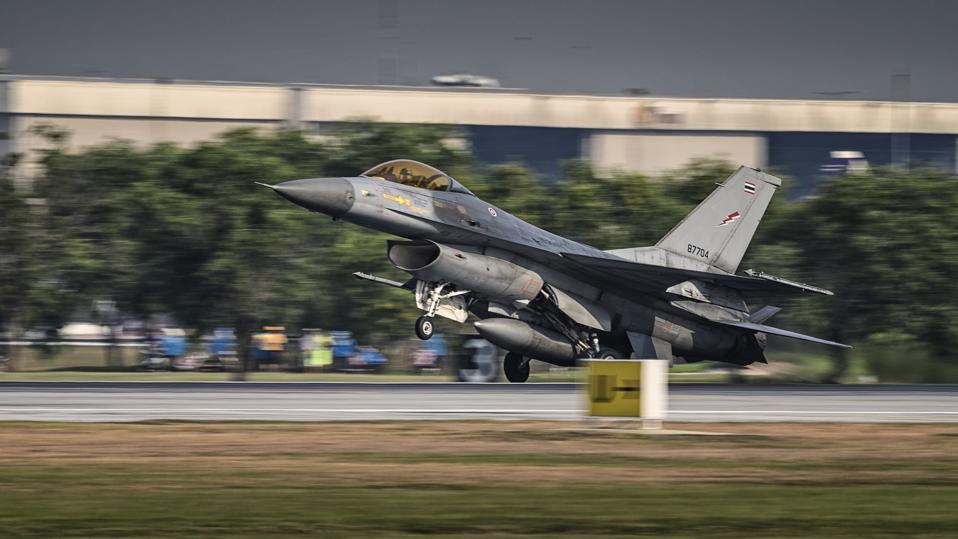
F16 military flight landing at Donmeung Airport
getty
On July 24 a long simmering border dispute between Cambodia and Thailand erupted as their respective armed forces vied for control of culturally important temple complexes and their environs along key sectors of the border: Preah Vihear to the east, and Prah Muen Thom and Ta Kwai to the west.
As in a preceding eruption of hostilities in 2011, infantry on the ground armed with small arms and support weapons seized and defended contested terrain which was also bombarded by rocket and howitzer artillery (including cluster munitions). But for the first time, drones and jet fighters armed with precision-guided weapons also joined the fray.
After five days of intense combat a ceasefire was reach at midnight July 29-30. By the latest count, the fighting resulted in at least 40 dead, including a high proportion of civilians, and displaced hundreds of thousands of more people from their homes.
The clash of Cambodian and Thai forces involved a mix of western and eastern weaponry, both old and new. While Cambodia’s military is supported by China (and was by Vietnam prior), Thailand’s military was armed by the United States, Israel, Ukraine, France, Sweden and others. But Bangkok too had increasingly turned towards China in recent years, both for weapons and joint military exercises. This heavy weaponry
Note: Confirming actions in military conflicts (especially recent/ongoing ones) is difficult due to prevailing confusion, optimism bias regarding own-side performance, and propaganda aimed at influencing public perceptions. This account considers both the claims and allegations made by the warring parties, and credible video imagery of the conflict.
Rocket artillery
Both Thailand and Cambodia have large and diverse arsenals of artillery, with Cambodia particularly invested in rocket artillery. The violent clashs this July were preceded by months of mostly non-violent confrontations between Thai and Cambodian troops asserting control over contested areas.
Thai accounts mark a bombardment by Cambodian BM-21 Grad rockets on the morning of July 24 near Ta Muen Thom temple, which reportedly killed 11 Thai civilians and a soldier, as leading to larger-scale hostilities and retaliatory strikes (see below).
Cambodian soldiers tride a truck equipped with a Russian-made BM-21 rocket launcher in Cambodia’s northern Oddar Meanchey province, which borders Thailand, on July 27, 2025. Thailand and Cambodia clashed for a fourth day on July 27, despite both sides saying they were ready to discuss a ceasefire after a late-night intervention by US President Donald Trump. (Photo by TANG CHHIN Sothy / AFP) (Photo by TANG CHHIN SOTHY/AFP via Getty Images)
AFP via Getty Images
Multiple rocket launch systems (MRLSs), typically mounted on trucks, can very rapidly unleash large salvoes of rockets saturating a broad area with high explosives—imprecise, but shocking in scale and intensity.
The Soviet 122-millimeter Grad rocket, dating back to the 1960s, is perhaps the most widely used on the planet, compatible with diverse truck-launchers. Cambodia uses the original Soviet BM-21 launchers, Czech RM-70s on 8×8 trucks, Chinese PHL-81s (reverse-engineered from a BM-21 captured from Vietnam) and succeeding PHL-90Bs with improved fire control systems. Meanwhile, Thailand uses Chinese PHL-11s (or SR-4s).
Cambodian soldiers gesture while standing on a Czech 8×8 RM-70 MLRS truck-launcher travelling along a street in Oddar Meanchey province on July 25, 2025. Thailand and Cambodia fought their bloodiest military clashes in more than a decade on July 24, with at least 12 people killed as the two sides battled with tanks, artillery and ground forces over a disputed border zone. (Photo by TANG CHHIN Sothy / AFP) (Photo by TANG CHHIN SOTHY/AFP via Getty Images)
AFP via Getty Images
All of these systems have barrels sufficient to unleash 40 rockets in one salvo, with the PHL-90Bs and RM-70s also carrying a reload salvo of ammunition. Typical Grad rockets have a maximum range of 12 miles, though extended-range rockets may reach twice as far or further.
Larger-caliber rockets than Grads typically have considerably greater range—enough to strike distant military bases or population centers. Such deep strikes might trigger a broader, more destructive conflict, however.
In this regard, Cambodia disposes of six PHL-03 launcher trucks with 12 tubes each packed with 300-millimeter rockets with a range of at least 81 miles. Meanwhile, Thailand operates license-built DTI-1s and DTI-1Gs (based on Chinese WS-1B and WS-32 respectively) carrying four 302-millimeter rockets. The DTI-1G in particular can launch satellite-guided missiles out to 87 miles using China’s Beidou satellite network, allowing much more precise strikes using a lower volume of rockets.
Technically, Cambodia’s PHL-03 supports a Fire Dragon-140 guided munition too, but it’s not confirmed that Cambodia acquired any.
Ultimately, it doesn’t appear either side attempted deep strikes outside the disputed areas, though Thai media claimed the destruction of a Cambodian PHL-03 via air strike.
Thai and Cambodian howitzer artillery also saw extensive action. Thailand has acquired over hundreds of 105- and 155-millimeter towed howitzers from diverse countries, as well as M109 tracked armored howitzers, and modern French Caesar and Israeli ATOMS-2000 truck-mounted howitzers (all 155-millimeter caliber) with more sophisticated guidance capabilities.
Cambodia has diverse, mostly older Soviet and Chinese artillery systems, particularly 122-, 130- and 152-millimeter field guns and howitzers.
Royal Thai Army Soltam M-71 155-millimeter howitzer of Israeli manufacture positioned at a base near the Thai-Cambodian border in Surin province, northeastern Thailand, Saturday, April 23, 2011. Thai and Cambodian troops fired shells and small arms across the countries’ border Saturday, killing at least 10 soldiers in a two-day clash. (AP Photo) THAILAND OUT
Copyright 2011 AP. All rights reserved.
Prior to the conflict on May 30, Cambodia deployed some of its most modern artillery: around a dozen Chinese-built SH-1 122-millimeter howitzer trucks (PCL-09s in Chinese service) to the border. ATMOS 2000s—known as M758s in Thai service—were recorded in action during the conflict–as were M101 howitzers of World War II pedigree, and Soviet D-30 122-millimeter systems by Cambodia.
Howitzers were a likely vector for cluster munitions the Thai army says it used to target Cambodian military positions (though aerial or rocket systems are possible too). The controversies surrounding cluster weapons will be discussed in a separate article.
Air power and air defense on the Thai-Cambodia border
Thailand’s military elected to employ combat aircraft for the first time to retaliate against the Cambodian rocket bombardment on July 24. As the Royal Cambodian Air Force no longer has any operational combat aircraft–other than a mix of Soviet and Chinese Z-9 transport/utility helicopters–it could not intercept such raids or retaliate in kind.
The initial raid involved six Thai F-16s which struck the command posts of Cambodia’s 8th and 9th divisions, allegedly controlling the responsible rocket units.
F-16s continued to be deployed on strikes in subsequent days, including strike package on July 26 including two F-16s and two of the RTAF’s newer Gripen jets imported from Sweden, marking the first combat use of this aircraft type nearly three decades after it entered operational service. This attack reportedly targeted two Cambodian artillery positions with 500-pound GBU-12 Paveway II laser-guided bombs.
World Air Forces estimates Thailand retains 35 or 36 operational F16As and-two-seat F-16Bs in three squadrons based at Korat and Takhli airbases, out of 52 imported from the U.S. PEACE NASREUN or donated by Singapore. Furthermore, eighteen of those F-16s received a Mid-Life Update in the 2010s integrating more modern computers supporting longer range sensors, weapons and self-defense systems.
Thai F-16 landing at Donmeung Airport
getty
Meanwhile, the RTAF also retains 11 of its original twelve single-seat Gripen-Cs and two-seat Gripen-Ds, distinguished by their additional pair of small, bendable ‘canard’ wings close to the cockpit. Though Gripens have lower thrust-to-weight ratio than F-16s, they also have a smaller radar-cross section, lower operating costs, and can safely operate from much shorter improvised runways. Thai Gripens reportedly outfought Chinese J-11 jets in beyond-visual-range air-to-air combat in a 2015 exercise.
SINGAPORE, SINGAPORE – FEBRUARY 20: A Saab JAS 39 Gripen of the Royal Thai Air Force (RTAF) is on display during the Singapore Airshow at Singapore’s Changi Exhibition Centre on February 20, 2024 in Singapore. The airshow kicked off on February 20 and will last until February 25. It is attended by over 1,000 participating companies and is expected to attract 50,000 trade attendees from over 50 countries and regions. (Photo by Zhang Hui/VCG via Getty Images)
VCG via Getty Images
In terms of weaponry, the RTAF is known to have acquired French ATLIS-II laser/optical targeting pods used in conjunction with Paveway II laser-guided bombs (actually upgrade kits that convert regular 500 and 2,000 lb. bombs into smart munitions.) It also has imported newer GPS-guided KGGB glide bombs from Korea with a ranges exceeding 50 miles (depending on release altitude) and shorter range AGM-65D and G Maverick missiles using imaging infrared guidance.
Such guided munitions are significant, not just because they enable more precise and effective attacks, but also allow the jets to engage targets from sufficient standoff that they may avoid short-range air defenses, such as the Cambodian’s army’s Chinese-built man-portable missiles and Soviet anti-aircraft guns.
While Cambodia lacks jet fighters, in 2023 the Royal Cambodian Army did acquire batteries of Chinese KS-1C medium-range surface-to-air missiles (or HQ-12s in Chinese service) integrated alongside H-200 phased array radars for targeting. If forward deployed to the border area–which has its risks–a KS-1C battery could potentially threaten Thai jets with their maximum engagement range of 43.5 miles and altitude of 86,000 feet.
However, Thailand also imported KS-1Cs from China and thus may have tested them to devise effective countermeasures. Furthermore, Thailand operates Erieye AWACS jets from Sweden that may have help its fighters avoid air defense threats. Despite rumors alleged the downing of an F-16 jet, no evidence has emerged supporting this claim.
The RTAF’s old American F-5 light fighters (due for retirement in 2031) and German/French Alphajet trainer/attack aircraft do not appear to have been deployed. Bangkok is now seeking to acquire an additional squadron of more advanced Gripen-E/F jets from Sweden, though Stockholm may be evaluating whether Thailand’s combat use of Gripens accorded with their views on international law before authorizing further sales.
Drones in the Thai-Cambodia conflict
Russia’s full-scale invasion of Ukraine begun in 2022 subsequently revealed that even small, short-range civilian-grade drones—produced in vast quantities at low prices by China—are remarkably effective not only as reconnaissance systems, but easily converted into precise yet very cheap guided weapons, either by gravity dropping grenades or as kamikazes with anti-tank warheads.
Despite Cambodia’s close ties to China, by far the world’s greatest exporter of low-cost drones, as well as testing of Chinese drones over Cambodian airspace, the border conflict did not offer evidence that Cambodia’s armed forces had integrated drones extensively, though Cambodian civilians did document on social media projects to convert drone bombers.
Thailand, however, released videos of quadcopter drone attacks on Cambodian positions employing gravity-dropped munitions, reportedly 60-millimeter M261 and M472 mortar rounds. One attack falls into a position claimed to store 122-millimeter Grad rockets. A drone also allegedly destroyed a loaded RM-70 rocket artillery truck.
Cambodian troops recorded themselves shooting down one such quadcopter drone with small arms fire. Another video of a close call might indicate Cambodian efforts to target drone teams.
However, there was little evidence of electronic warfare on the battlefield which might have disabled drones by jamming video, navigation and control signals.
Thailand also appears to have employed some fixed-wing kamikazes drones which plummet into their targets before exploding.
On one level, the July 2025 Thai-Cambodia border conflict remained a traditional struggle for physical control over territory-one in which infantry on the ground saw significant action.
However, ‘indirect’ fires by artillery, jets and remotely-piloted aircraft may have inflicted a greater share of casualties and attracted disproportionate media attention. Recordings of successful drone attacks and air strike provided rare tangible proof of tactical successes in the conflict, when it’s otherwise vastly more common to show firing at targets than fires hitting targets. And that can influence perceptions in ways that affect political decision-making.
The degree to which indirect fires weapons caused civilian casualties may further have affected public opinion on both sides and decisions by military and national leaders.
While the Thai-Cambodia border conflict did not involve strictly new technologies, it nonetheless demonstrated evolving impact of indirect fire weapons, air power and drones on a long-running border dispute. That deserves continuing scrutiny in an era where the recourse to force appears increasingly common between states.