

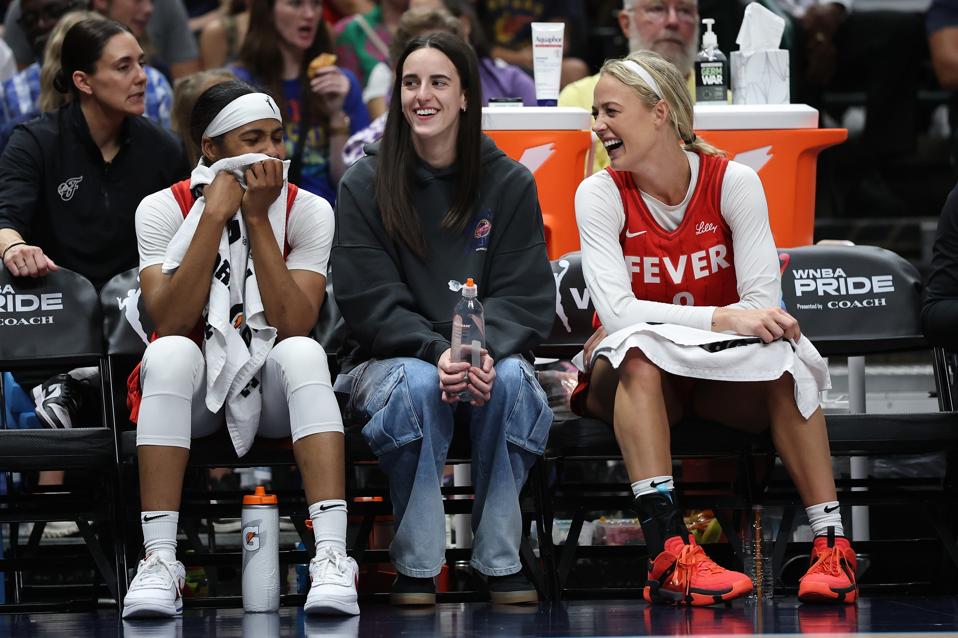
A groin injury has kept Caitlin Clark #22 sidelines. Here she is seen on the bench with Indiana … More
You could say that the status of Caitlin Clark for the WNBA Commissioner’s Cup is of groin concern. The star point guard has missed the Indiana Fever’s last two games not because of a fever, but because of a left groin injury. It’s not clear yet whether this injury will keep her out of Tuesday night’s WNBA Commissioner’s Cup championship game against the Minnesota Lynx.
Clark had only recently returned from a left quadriceps strain that she had suffered early in June and had led to her missing three weeks encompassing five games of the season. Clark returned from that injury on June 14 game against the defending WNBA champion New York Liberty. She made quite a splash in that return, making seven three-pointers and scoring a season-high 32 points in the Fevers 102-88 victory over the Liberty. But she has been left struggling, so to speak, ever since.
What Is A Groin Strain?
Clark’s injury this time is probably another type of muscle strain. A muscle strain is when you overstretch or tear the fibers of one or more of your muscles. Recently, in a Forbes article about a muscle strain suffered by another Indiana basketball player, the Pacers Tyrese Haliburton, I laid out how muscle strains typically are classified into one of following three categories:
- Grade 1 “Mild”: Here the muscle fibers have been stretched with potentially a small amount of tearing. While you may have felt a sharp pain right at the injury’s occurrence, symptoms may not persist.
- Grade 2 “Moderate”: Here there’s been a tear through at least some and up to most of the affected muscle fibers. This is where the strength or range of motion of your muscle is impaired.
- Grade 3 “Severe”: Here’s where there’s been a complete tear through the affected muscle fibers. Significant bruising and swelling can result. If complete muscle rupture has occurred, surgery may be necessary to reattach the portions of the muscle back together.
Your groin muscles help connect your lower abdomen to your thighs, making them pretty darn important. After all, you don’t want your thighs to go off and do whatever they feel like doing. Plus, you use your groin muscles whenever you run and jump. These muscles consist of the following three muscle groups: your lower abs, your iliopsoas muscles, which connect your spine to your hips and legs and your six adductor muscles in your hips and thighs, as described by the Cleveland Clinic website.
Groin strains can happen with any motion that rapidly stretches these muscles too quickly or too far. They can also result from repeatedly stretching these muscles without adequate rest. A direct blow to the groin can cause a groin strain as well, which is yet another reason why you shouldn’t let your friends kick you in the groin.
Could Clark’s left quadriceps injury have pre-disposed her to the left groin injury? Well, any lower extremity injury can throw off the mechanics and thus put more stress and strain on other parts of the body. That can, in turn, make you more susceptible to other types of injuries if the original injury hasn’t fully healed yet and you haven’t had the chance to get fully back into the shape you were in before well before the first injury.
How Are Groin Strains Diagnosed?
Caitlin Clark #22 of the Indiana Fever dribbles against Erica Wheeler #17 of the Seattle Storm … More
Typically, groin strains are diagnosed through a history and physical exam. You tend to feel soreness or other types of pain in the area. Gently pushing and pulling on the area will elicit such symptoms. Naturally, you should be careful when handling that area. It’s not a good idea to mash aggressively on your groin for many reasons.
Your range of motion there also may be limited. So your doctor may test how far your can flex and extend your hips. Again, this should be done gently. This is not the time to go all Simone Biles and attempt some splits.
A doctor may order imaging like ultrasound, X-rays or an MRI to judge the extent of the injury, evaluate for complications and rule out other possibilities such as a hernia. An ultrasound may detect swelling and fluid accumulation. An X-ray is mainly to look at the joints and bones. An MRI can actually see tears in the muscles.
How Are Groin Strains Treated?
The classic treatment for muscle strains in general is RICE. No, not the stuff that you eat with sashimi. But RICE the acronym that stands for Rest, Ice, Compression and Elevation.
Rest is key because this is not the time to try different tricks with your groin.
Ice the area with an ice pack or cold compress. But make sure that you don’t leave such cold stuff on there for longer than 15 minutes at a time. Otherwise, you may damage the skin with something like frostbite. Compression means wrapping your thigh with compression bandages or wraps or wearing a pair of compression pants. Finally, elevation is keeping your leg and lower body above the level of your heart.
Anti-inflammatories like ibuprofen can help. But beware of overdoing their use. Surgery is usually not necessary unless it is a grade 3 tear that requires the muscles being reconnected.
How Long Does Recovery From A Groin Strain Take?
The recovery period depends on the grade and severity. A grade 1 or 2 strain usually takes about a month or two to completely heal. Grade 3 strains take longer like at least several months. Of course, not all groins are created equal. So, some may recover faster than others.
And Caitlin Clark is not like many other people. Who knows if her body may heal at a quicker timeline than most. At the same time, the Fever shouldn’t rush Clark back if it means risking further and more chronic problems. She’s been a big star for not only the Fever but also the WNBA. So you could say that the growing attention to the league does depend on what happens to her groin.