

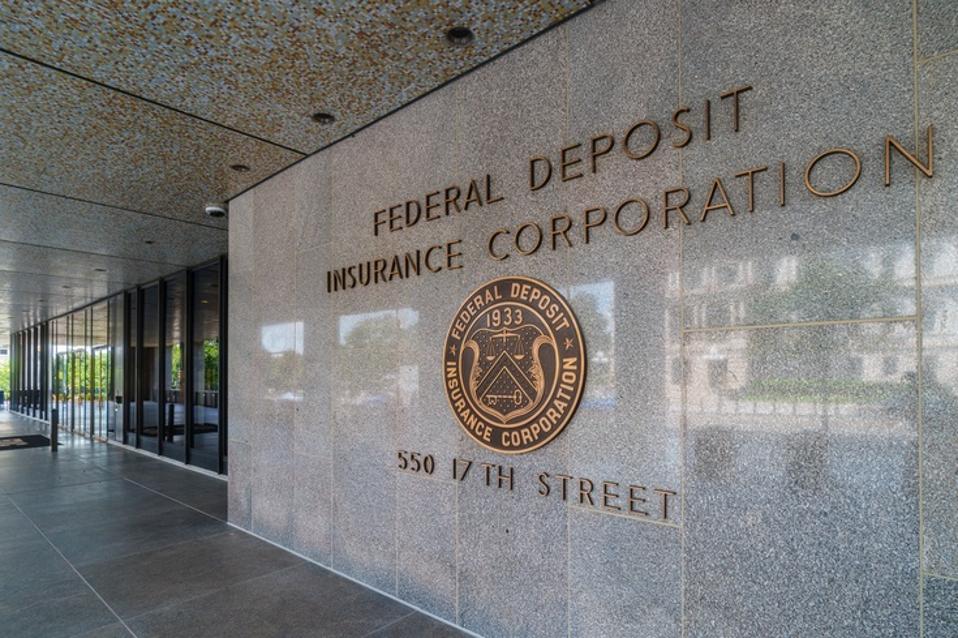
WASHINGTON, DC – AUGUST 18: The entrance to the Federal Deposit Insurance Corporation (FDIC) is seen on August 18, 2024, in Washington, DC. (Photo by J. David Ake/Getty Images)
Getty Images
Banks aren’t in the business of losing money. In an opinion piece meant to make a case against increasing federal deposit insurance, it’s important to state the obvious up front.
Precisely because banks make their money on the spread between the rate paid for deposits and the rate at which deposits are loaned out, there’s little to no incentive for banks to originate loans that won’t be paid back. That’s because one bad loan can erase the gains of a much bigger number of good loans.
Which brings us to the proposal to increase federal deposit insurance from $250,000 per non-interest-bearing account to $10 million. It’s hard to countenance in consideration of the business banks are in exactly because they’re not in the business of losing money born of big, audacious swings for the proverbial fences with depositor savings. Again, one errant, particularly risky loan within a bank can easily wipe out the returns on 99.9999% of the good ones.
Which is why increased deposit insurance would be so harmful to – yes – banks themselves. That’s because nothing is free, and this includes deposit insurance.
As has been reported widely, a substantial increase in deposit insurance per account would cost banks $10 billion in the very near term, along with surely more in the future. The latter is made evident by existing deposit insurance that for instance cost banks $12 billion in 2024 alone. Do the math.
The costs associated with maintaining insurance on much higher deposit levels would plainly hurt banks owing to precious capital flowing into the FDIC’s deposit insurance fund instead of profitable loan origination. Which means banks would lose twice under such a scenario: they would pay more for insurance that is oblivious to the business they’re in, all the while doing less banking (the business they are in) thanks to costs imposed on them to maintain a much bigger insurance umbrella. It’s just not necessary.
To which some will say that the insurance is necessary on the supposition that the errors of badly managed banks must be contained through the FDIC. Such a viewpoint is exactly backwards. If banks are poorly managed, or inartful at originating loans, the answer isn’t more federal insurance, rather they should be acquired quickly so that they can’t commit costly errors. Call expanded FDIC insurance a subsidy of the smallest, and frequently worst banks at the expense of the biggest and best ones.
Evidence supporting the above claim can yet again be found in the proposal itself. If a bank’s lending requires such substantial insurance, then it shouldn’t be in the banking business. See this opinion piece’s opening sentence.
It can’t be said enough that if banks are operating as banks should be, by carefully making loans to credible borrowers, nosebleed levels of insurance are superfluous. Thought of another way, banks clamoring for $10 million per account in FDIC insurance are either inept, or plainly not in banking. The former should be acquired, while the latter shouldn’t have their risky behavior subsidized.