

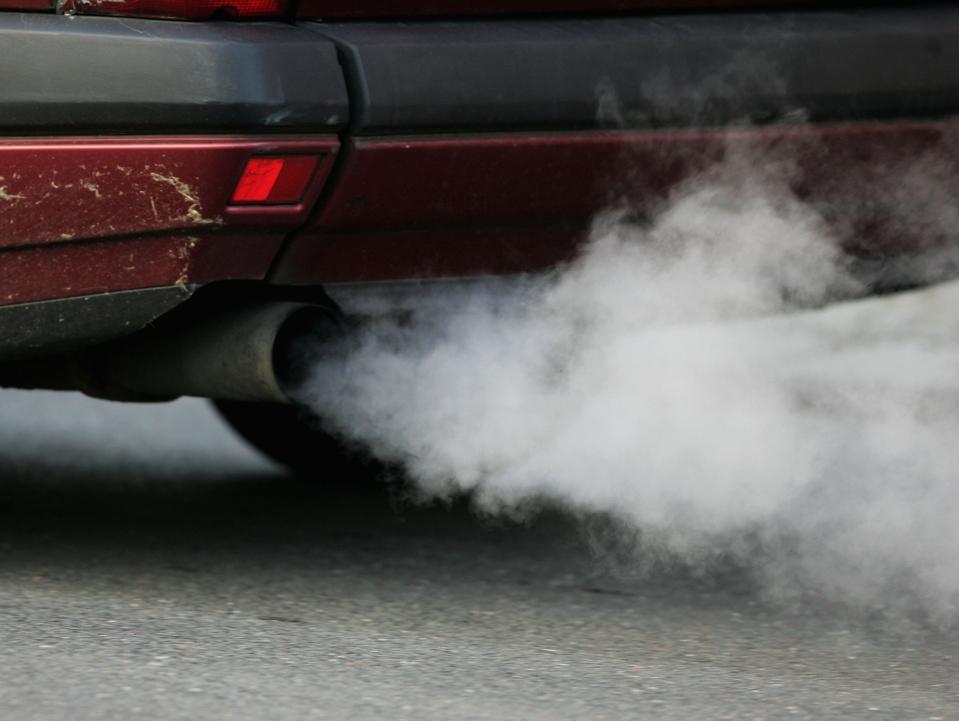
BERLIN – FEBRUARY 07: An vehicle’s exhaust pipe releases fumes on February 7, 2007 in Berlin, … More
I recently wrote a piece debunking weather conspiracy theories. One of the featured topics was “chemtrails.” Some people believe condensation trails (“contrails”) coming out of airplanes are chemtrails being used to control the climate, our minds, or whatever. In that article, I explained what contrails are and pointed to scholarly evidence refuting “chemtrail” narratives. However, a follower on one of my social media platforms made a great point. “Chemtrails” that we should be concerned about are right in front of us everyday – exhaust from cars.
LONDON, ENGLAND – MARCH 12: Two commercial airliners appear to fly close together as the pass over … More
According to a National Weather Service website, contrails are, “Cloud-like streamers frequently observed to form behind aircraft flying in clear, cold, humid air.” They can be formed by water vapor that overcomes combustion heat or from aerodynamic pressure reduction from air flow around wing tips or propellors. Yes, I know this is not a perfect analogy, but on a cold day, our breath produces something similar to a contrail.
TORONTO, ON – February 3 – The breath of a worker on Yonge St. can be seen in the air on a bitterly … More
So what’s in the exhaust fumes from an automobile? Most cars emit a chemical stew of things. Carbon dioxide, though non-toxic, is a primary contributor to climate warming and ocean acidification. Carbon monoxide is quite toxic, but new engines produce less of it than older cars. It can also interact with other constituents in the atmosphere to affect certain greenhouse gases like methane or ozone. Nitrogen oxides are inherent to most combustion engines and are contributors to photochemical smog. Sulfur dioxide can also contribute to air pollution. Other ingredients in the exhaust pipe “stew” include hydrofluorocarbons (HFC) and benzene.
FILE – In this Jan. 26, 2009 file photo, cars give off exhaust fumes in Montpelier, Vt. The state of … More
Diesel engines may actually emit small particles of metal and black soot. Laurence Allan wrote, “Modern cars are fitted with diesel particulate filters (DPFs) to reduce the number of harmful particles being pumped out into the atmosphere.” Particulate matter can cause or amplify certain health ailments.
FILE – Smog lingers over the city overlooking the Ports of Long Beach and Los Angeles as seen from … More
The EPA website noted, “The Clean Air Act, which was last amended in 1990, requires EPA to set National Ambient Air Quality Standards (40 CFR part 50) for six principal pollutants (“criteria” air pollutants) which can be harmful to public health and the environment.” These pollutants are carbon monoxide, lead, ozone, nitrogen dioxide, sulfur dioxide, and particulate pollution. Government regulations and recent trends in alternative energy transition have led to cleaner air.
Clean Air Acts and EPA regulation have produced progress on cleaner air since 1990.
As for carbon dioxide, an EPA website pointed out the following facts:
- The average passenger car emits roughly 4.6 metric tons of carbon dioxide per year.
- The average passenger car emits around 400 grams of carbon dioxide per mile.
- Carbon dioxide emissions from one gallon of gasoline is 8,887 grams CO2. It is even slightly higher for diesel.
Carbon dioxide values continue to rise globally, and climate continues to change, naturally and through these anthropogenic contributions.
Trends in atmospheric carbon dioxide.