

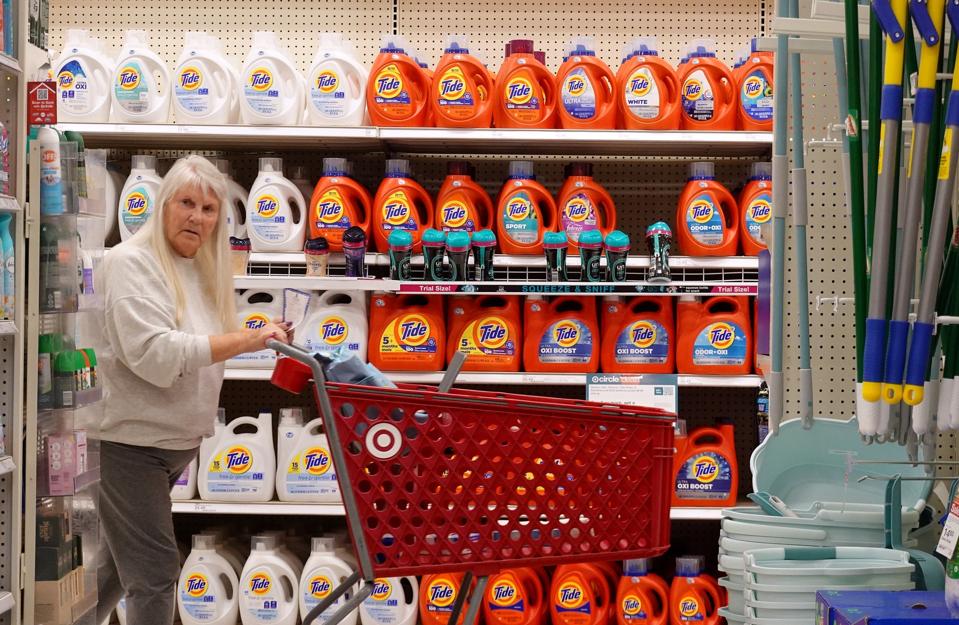
NOVATO, CALIFORNIA – JUNE 05: A customer walks by a display of Tide detergent at a Target store on June 05, 2025 in Novato, California. Procter & Gamble announced plans to terminate up to 6 percent of its global workforce, or approximately 7,000 jobs, over the next two years as the consumer goods company navigates consumer uncertainty and the costs associated with the Trump administration’s global tariffs. (Photo by Justin Sullivan/Getty Images)
Getty Images
Target, long known for its stylishly designed stores and reputation as a progressive brand, is facing one of the toughest chapters in its history.
The company’s latest earnings highlight the scope of the challenge: sales in its most recent quarter fell just under 1% to $25.2 billion, profit dropped 19% year-over-year to $1.3 billion, and comparable-store sales slid nearly 2%.
Target announced today that Chief Operating Officer Michael Fiddelke will take over as Chief Executive Officer, succeeding Brian Cornell after an 11-year tenure. Cornell was at the helm of the retailer when it made its decision to scale back diversity, equity, and inclusion (DEI) programs—a reversal that sparked customer boycotts, reputational backlash, and questions about whether the brand abandoned the very values that once fueled its growth.
The financial pressures that have amassed since that decision in late January are unlikely to be relieved anytime soon as tariff uncertainty throughout their supply chain, and a consumer slowdown come into play.
As a result Target’s stock price (NYSE: TGT) is down 31%—from 137.40 on January 24, the day Target cut its programs—to $94.40 today, the opening price of the stock. That equates to over $13 billion loss in market cap.
Earlier this year I asked “Do Boycotts Still Work?.”
And if you look at these number, in addition to Placer.ai foot traffic, the answer is yes.
Was Target’s DEI Backlash A Self-Inflicted Wound?
Target’s decision to amend its DEI program signaled a shift that the brand would be changing its investment and priority in diversity efforts, which the company has been vocal about in the past, particularly around Black-owned businesses, where it committed to $2 billion in spend.
They built their brand on being inclusive and diverse. Pivoting became a risk, and soon thereafter, a movement began growing on social media, calling for an economic blackout day on February 28 against Target, alongside other retailers who made similar DEI changes. On that day, Target’s website traffic was down 9% compared with the same period last year.
In the background, Pastor Jamal Bryant launched TargetFast.org, calling on 100,000 conscientious citizens to fast from spending any money at Target for the 40 days of Lent, beginning Wednesday, March 5, and concluding on April 20 (Easter Sunday). Today, over 150,000 participants have stepped up, far surpassing the participation goal.
This slump in foot traffic coincided with the timing of the 40-day “fast.”
NOVATO, CALIFORNIA – MARCH 05: Watermelons from Mexico are displayed on a shelf at a Target store on March 05, 2025 in Novato, California. Target CEO Brian Cornell said in a television interview that price increases due to US President Donald Trump’s tariffs on Mexico could be seen on store shelves as early as this week. (Photo by Justin Sullivan/Getty Images)
Getty Images
The Role Of Tariffs: A New Challenge On The Horizon
As if Target’s challenges weren’t enough, the company now faces a new potential headwind: tariffs. On April 3, the stock hit $93.00—a 52-week low—on the day after the President Trump’s “Liberation Day” tariff announcement. And although things had appeared to rebound since then, some tariff patterns are starting to come into play. In a recent viral video, perforated prices have been removed from the tags, as high prices are displayed on the signage. While this video wasnt shot at a target store, many feel these type of actions will continue as supply chains catch-up.
For retailers like Target, which rely heavily on imported goods, these tariffs could exacerbate existing challenges. Higher import costs may force the company to raise prices, further alienating price-sensitive consumers already grappling with inflationary pressures. This could create a vicious cycle, where declining foot traffic leads to lower sales, which in turn makes it harder for the company to absorb higher costs. The timing of these tariffs is particularly problematic for Target, as it struggles to regain its footing.
While the company has yet to comment on how it plans to address these challenges, it’s clear that their new CEO who takes control on Februrary 1, 2026 will likely be in the hot seat from day 1.
NEW YORK, NEW YORK – APRIL 02: People shop at a Target store on April 02, 2025 in the Flatbush neighborhood of the Brooklyn borough in New York City. Target stores continue to see a decline in sales for the eighth consecutive week, extending a streak that began after the company announced it would end its diversity, equity, and inclusion (DEI) program in late January. The company, also like Costco and Walmart, is putting pressure on its Chinese suppliers to absorb some of the costs of U.S tariffs. U.S. President Donald Trump is expected make an announcement for another round of new tariffs on most imports to the United States, which the president has dubbed “Liberation Day.” (Photo by Michael M. Santiago/Getty Images)
Getty Images
The Intersection Of Business And Politics
Target’s current status offers a valuable lesson in navigating the complex intersection of business and politics, which is underscoring the importance of consistency. Adjusting a company’s DEI program may seem like an easy way to appease certain stakeholders in lieu of others, but the long-term consequences can be the questioning of consumer trust and loyalty.
Loyal customers are the goal of great business. Loyalty drives repeat purchases, reduces marketing costs, provides valuable feedback and contributes heavily to a brand’s overall resilience and growth. These metrics matter.
In this time of VUCA (volatility, uncertainty, complexity and ambiguity), companies must be willing to stand by their principles, even when it’s difficult. This is not only investing in their brand value but also serving as a bridge to continue to maintain and earn the trust and loyalty of their customers, both current and new.